|
ScheBo Biotech
Schebo Biotech AG.is a rapidly growing high-tech biotechnology company founded
in 1988. The company is dedicated to the development, production and worldwide
distribution of innovative tests for both human and veterinary diagnostics,
as well as food safety.
The antibody-based products of ScheBo® • Biotech are used in laboratories
and hospitals all over the world. ScheBo® Biotech is developing, producing
and distributing innovative tests (ELISA's) mainly for the diagnosis of gastro-enterological
disorders.
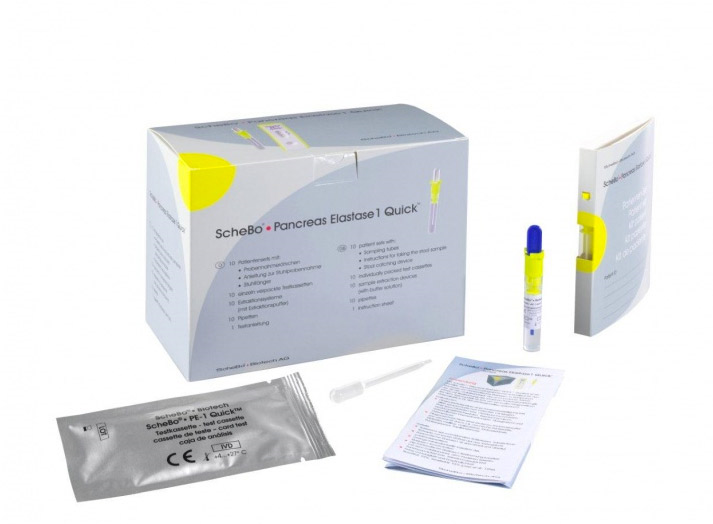
In medical diagnostics, ScheBo Biotech is well-known for the Pancreatic
Elastase
1 Stool Test (‘faecal elastase’), which is rapidly becoming recognized
as the “gold standard” of non-invasive pancreatic function tests.
Recent guidelines produced by the British Society of Gastroenterology, and the
Association of Clinical Biochemist members, recommend this convenient, non-invasive,
direct test of pancreatic exocrine function as "the test of first choice
in patients who present with diarrhoea of putative pancreatic origin". Highly
specific monoclonal antibodies to human Pancreatic elastase-1 enable quantitative
determination using a single pea-sized stool sample, obviating lengthy urine
or 72-hour stool collections. The development of the innovative Quick-Prep tubes
has made sample preparation for the test considerably faster and more pleasant.
ScheBo® has
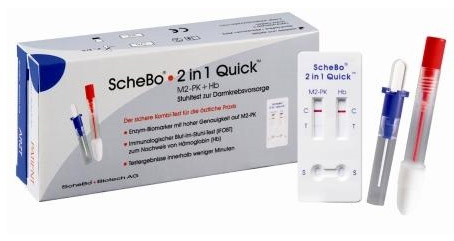
developed a very exciting new assay for the screening of Colon cancer,
namely the Fecal M2-PK Elisa, and the serum
M2-PK for follow-up monitoring after treatment.
This test demonstrates a sensitivity and specificity
of ~81%. The Fecal occult blood test ( FOBT)
only gives information on bleeding tumours,
whereas the M2-PK is indicative of any tumour
activity in the colon, and the accumulated
enzyme is measured in the stool. New and encouraging
results from clinical studies with the non-invasive
ScheBo Tumor M2-PK Stool Test, which is independent
of occult blood, show high sensitivity combined
with high specificity in colorectal cancer
screening
The M2-PK Test measures the dimeric
isoform of pyruvate kinase. The ScheBo Tumor M2-PK EDTA Plasma Test assists in monitoring the
efficacy of therapy, patient follow-up and
diagnosis in a wide range of different cancers,
including gastrointestinal, breast, lung and
urological tumours.
ScheBo® • Biotech AG developed and
launched a highly specific and very sensitive
test system for the detection of BSE-Risk Material
(brain and spinal cord) in meat and meat products
(BrainosticTM).
ScheBo® • Biotech has academic
alliances with several universities and university
hospitals in Europe, Israel, Canada and the
United States of America
'Better' bowel cancer test found
Scientists believe they may have found a much
more accurate way of diagnosing bowel cancer.
Researchers in Germany have discovered that
a chemical from cancer tumours leaks into the
bowel.
Writing in the British Journal of Cancer,
they said this chemical, called Tumour M2-PK,
can be found in the faeces of people with the
disease. They said testing for the chemical
could also enable doctors to find out how advanced
the disease is. The UK Gvernment is currently
considering introducing a bowel-screening programme.
One of the tests under consideration is the
faecal occult blood test (FOBT). It is used
to detect blood in the faeces - a symptom of
bowel cancer. However, the test cannot tell
whether the blood is caused by a tumour or
whether it is the result of something less
serious, such as piles. Only about six out
of every 100 people with a single positive
FOBT will have bowel cancer. This means that
many people who do not have cancer may have
to undergo unnecessary procedures.
More accurate
Scientists at Giessen University Hospital,
in Germany, believe their test is much more
accurate. They obtained faecal samples from
204 patients who were about ot undergo colonoscopies,
which involves inserting a tiny camera into
the rectum. The colonoscopy established that
60 of these had bowel cancer. The scientists
found that patients with the diesease had much
higher levels of Tumour M2-PK.
The scientists say further research is needed.
There is currently much interest in this area
of research
Professor Robert Souhami,
Cancer Research UK
Seite 1 von 2 BBC NEWS | Health|
"Better" bowel cancer test
found'
25.08.04 http://news.bbc.co.uk/1/hi/health/359418.stm
"We found a significant difference in
the level of Tumour M2-PK between those with
a confirmed diagnosis of bowel cancer and those
who were disease free," said Dr Phillip
Hardt, who led the study.
"There was also a very strong link between
the amount of enzyme found and how far the
cancer had spread." The scientists are
now planning further studies but they are confident
their findings could lead to a new test for
bowel cancer.
"We will now look to test Tumour M2-PK in a large trial, but his enzyme has the potential
to be an excellent safety net," said Dr
Hardt. "It could detect more cases of
the disease and possibly save unnecessary medical
procedures due to fewer false positive results."
Professor Robert Souhami, director of policy
and communication at Cancer Research UK, which
owns the British Journal of Cancer, welcomed
the study. "There is currently much interest
in this area of research," he said. "We
hope that enzymes such as this one will eventually
offer not only useful screening tools, but
also an effective method of monitoring bowel
cancer patients in remission, so that any return
of disease can be quickly detected and acted
upon."
www.schebo.com |